
howitreat.in
A user-friendly, frequently updated reference guide that aligns with international guidelines and protocols.
White Blood Cells
Neutrophil
- Morphology
- Size- 10-15 microns
- Nucleus has 2-5 distinct lobes and coarse chromatin
- Abundant cytoplasm with fine, pink/violet-pink granules
- Half-life in blood is 7hrs, while they function in tissues for 1-2 days.
- 0.85-1.6x10⁹ neutrophils/Kg are produced every day
- Death of neutrophils occurs by apoptosis
- Types of granules (Contents of granules change as the cell matures)
- Primary (azurophilic)- Contain myeloperoxidase, lysozymes, defensins etc.
- Secondary (specific)- Contain collagenase, sialidase, lactoferrin etc
- Tertiary (Gelatinase)- Contains gelatinase, acetyl transferase and lysozyme
- Secretory vesicles
Eosinophil
- Morphology
- Size- 10-15 microns
- Nucleus has 2-3 distinct lobes and coarse chromatin
- Abundant cytoplasm with large, coarse, uniform sized, crimson red numerous granules
- Half-life in blood is 18hrs, while in tissues they may live for several weeks.
- Death occurs due to apoptosis, which is enhanced by glucocorticoids.
- Proteins present in the granules:
- Major basic protein
- Eosinophil cationic protein
- Eosinophil peroxidase
- Eosinophil derived neurotoxin
- They help in control of parasitic infections
Basophil
- Morphology
- Size- 10-15 microns
- Nucleus has 2-3 distinct lobes and coarse chromatin, nuclear details are obscured by granules
- Abundant, cytoplasm with large, coarse, uniform, bluish-black granules.
- Granules are metachromatic and contain histamine and heparin
- They mediate immediate hypersensitivity reaction
Monocyte
- Comprise 1-9% of WBCs
- Normal absolute count: <1000/cmm
- They mature to form macrophages
- Immunophenotype: CD45+, CD4+, CD68+, CD163+ and lysozyme+
- Macrophages form the mononuclear phagocyte (reticulo-endothelial) system which consists of
- Kupfer cells in liver
- Alveolar macrophages in lung
- Littoral cells in spleen
- Langerhans cells in skin
- Microglial cells in brain
- Macrophages in bone marrow
- Osteoclasts in bone
- Type A cells of synovium
- Functions of these cells include:
- Phagocytosis and degradation of both soluble and particulate substances
- Act as antigen presenting cells
- Stimulate proliferation of lymphocytes through release of various cytokines
- Removal of cells that have undergone apoptosis
- Dendritic cells:
- Have projecting cytoplasmic dendrites.
- Process antigens for presentation to T cells
- Subtypes include:
- Langerhans cells: S100 protein+, CD1a+, CD207+, CD4+
- Indeterminate dendritic cells: S100 protein+, CD1a+, CD207-, CD4+
- Interdigitating dendritic cells: S100 protein+, CD1a-, CD207-, CD4+
- Interstitial dendritic cells: Fascin+, factor XIIIa+, CD4+/-
- Plasmacytoid dendritic cells
- Immunophenotype: CD123 (IL-3R)+, CD303, (BDCA2)+, CD304 (BDCA4)+, TCF4+
- Play role in antiviral immunity and systemic autoimmunity
Figures:
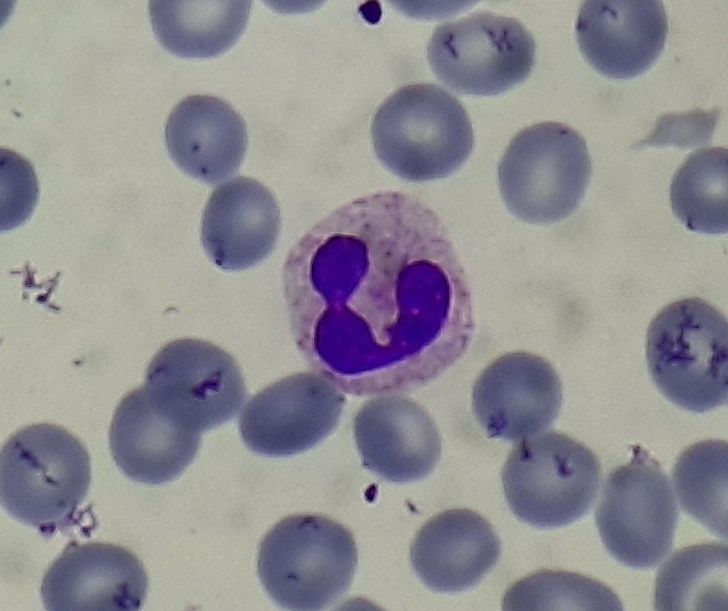
Figure 1.3.1 - Neutrophil

Figure 1.3.2 - Eosinophil
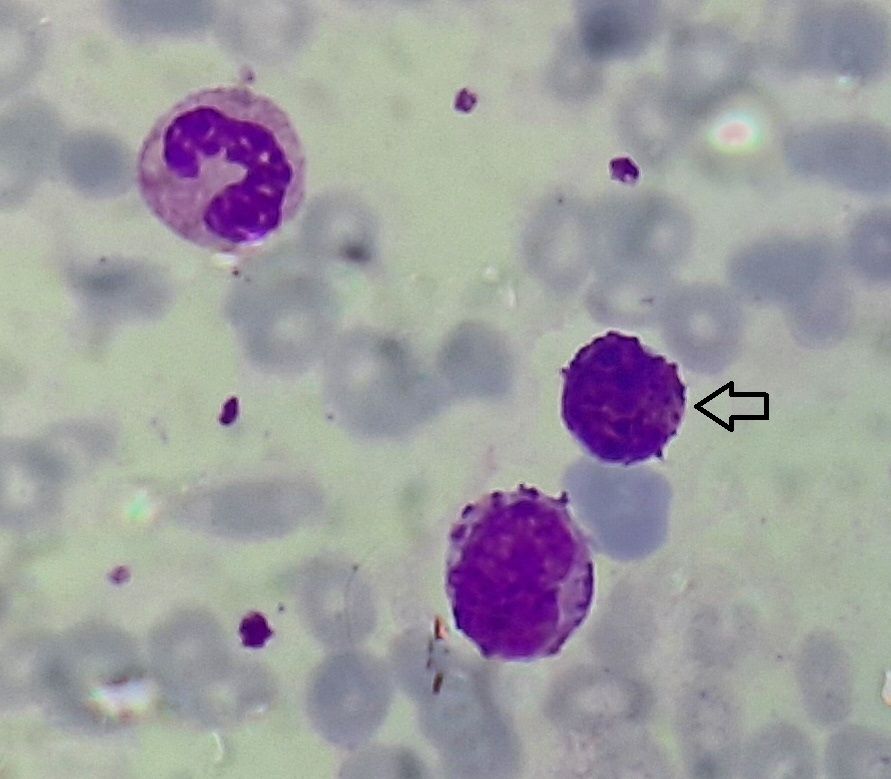
Figure 1.3.3 - Basophil (Arrow)
An Initiative of
Veenadhare Edutech Private Limited
1299, 2nd Floor, Shanta Nivas,
Beside Hotel Swan Inn, Off J.M.Road, Shivajinagar
Pune - 411005
Maharashtra – India

howitreat.in
CIN: U85190PN2022PTC210569
Email: admin@howitreat.in
Disclaimer: Information provided on this website is only for medical education purposes and not intended as medical advice. Although authors have made every effort to provide up-to-date information, the recommendations should not be considered standard of care. Responsibility for patient care resides with the doctors on the basis of their professional license, experience, and knowledge of the individual patient. For full prescribing information, including indications, contraindications, warnings, precautions, and adverse effects, please refer to the approved product label. Neither the authors nor publisher shall be liable or responsible for any loss or adverse effects allegedly arising from any information or suggestion on this website. This website is written for use of healthcare professionals only; hence person other than healthcare workers is advised to refrain from reading the content of this website.